Publications

The BC Society of Transition Houses actively develops resources and publications on an ongoing basis and is happy to provide you with access to its large collection.

We encourage the sharing of this material with others and ask that you please acknowledge BCSTH as the source when you do.

Search our publications by keyword or topic.

Publications

2009 | 
CWWA | 
Brochure

cwwabrochureThis brochure describes the Children Who Witness Abuse (CWWA) Program, its purpose, goals and services. The program is an intervention/ prevention program created by the BC Society of Transition Houses (formerly BC Yukon Society) to address the needs of children and youth ages 3 – 18 who have been exposed to domestic violence.

2009 | 
CWWA | 
Best Practice

cwwabestpracitcesBest Practices for the Children Who Witness Abuse Program is a manual for Children Who Witness Abuse (CWWA) counsellors. It summarizes theoretical information that is important to the development of a CWWA counsellor’s perspective, such as what it means to work from a feminist perspective and how knowledge of child development informs our practice. It touches on specific topics such as working with parents (both offending and non-offending), safety planning, and how to maintain one’s own wellness while doing this difficult work. It also covers standards of practice, administrative and legal issues that help a CWWA counsellor manage the program, and sample forms and policies.

Written by Ellen Barbeau, Ph.D. Funded by the BC Ministry of Housing the Social Development.

2013 | 
Children, CWWA, VIP, Youth | 
Best Practice, Poster

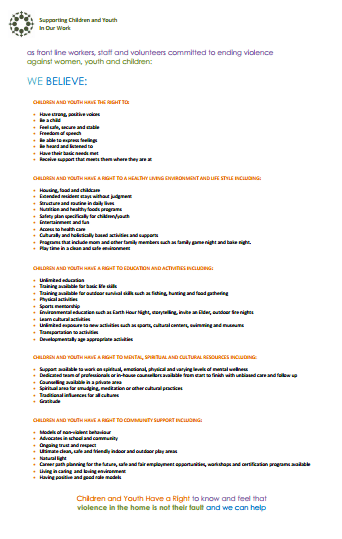
childrenposterThis poster outlines BCSTH’s Philosophy on Children and Youth. It states the beliefs of frontline workers, staff and volunteers committed to ending violence against women, youth and children. Children and youth have a right to know and feel that violence in the home is not their fault and we can help.

2012 | 
Children, CWWA, Youth | 
Best Practice, Guidebook

cwwa20The Children Who Witness Abuse Program’s 20 Most Commonly Asked Questions from New Workers provides all anti-violence workers with a rationale for working with children and youth who have been exposed to violence in the home; resource suggestions for developing a program; suggestions for community outreach, and suggestions for additional resources, which provide sample forms to assist with intake, assessment, group sessions and program evaluation.

The original Children Who Witness Abuse Program Handbook: 20 Most Commonly Asked Questions was funded by the Vancouver Foundation in 1995 and compiled by Sharon White and edited by Jodie McConnell. The BC Society of Transition Houses updated this resource in 2012 to meet the current needs of CWWA Programs. The focus of this version has changed slightly as it aims to answer questions from new CWWA workers working in existing programs. New workers may have inherited intake and assessment forms, session outlines, and CWWA policies; therefore, this document aims to fill in the gap of information that may have been lost since the inception of CWWA programs in 1992.

2013 | 
CWWA | 
Evaluation, Report

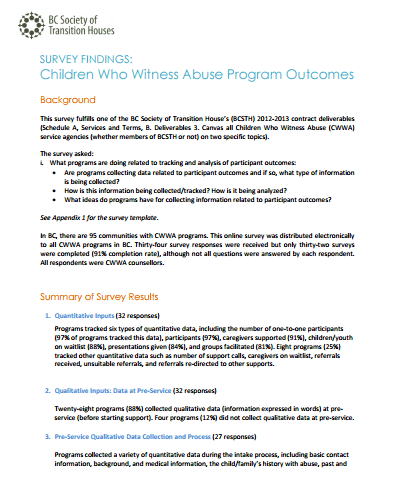
CWWAprogramoutcomesThis document reports on a 2012 survey of all Children Who Witness Abuse (CWWA) programs concerning how they report program outcomes. It asks how data related to participant outcomes is collected, tracked and analyzed, and how programs could be collecting information related to participant outcomes.